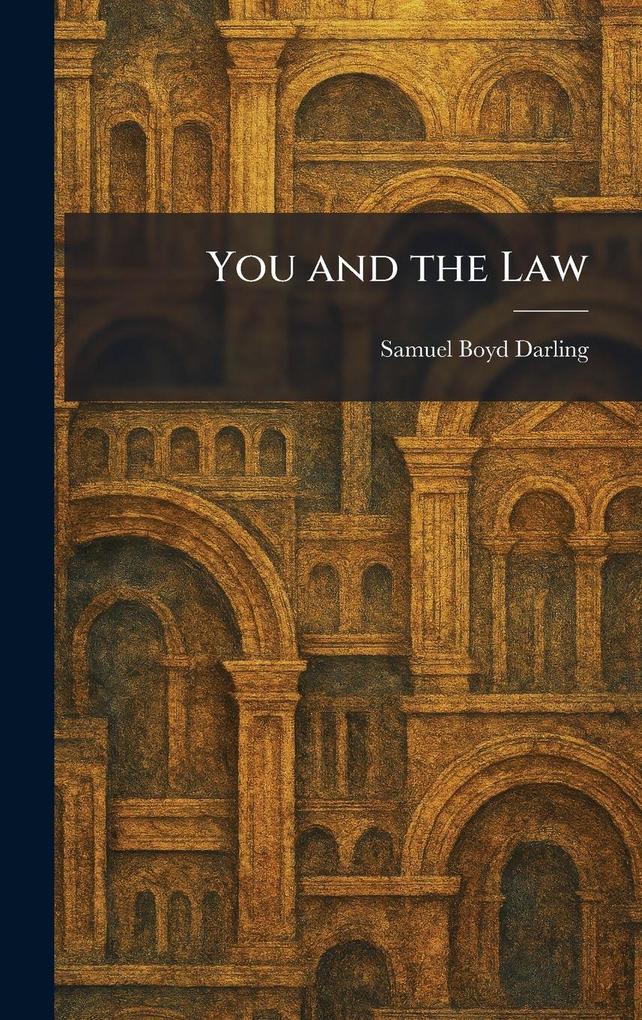
"You and the Law" is a comprehensive and accessible guide designed to introduce the layperson to the complexities of the American legal system. Written by Samuel Boyd Darling, this work demystifies legal principles and provides practical insights into how the law affects everyday life. The book serves as a vital reference for understanding the rights and responsibilities of the individual within society, covering essential topics ranging from contracts and property to domestic relations and personal liability.
Presented in a clear and straightforward manner, "You and the Law" bridges the gap between professional legal jargon and the needs of the general public. It offers readers a historical perspective on the early 20th-century legal framework, providing a fascinating look at the evolution of civil and criminal law. Whether used as a practical handbook or a historical study of legal education, this work remains an important resource for anyone interested in the foundational aspects of justice and the legal process. By highlighting common legal pitfalls and explaining fundamental concepts, Darling empowers readers to navigate the legal world with greater confidence and understanding.
This work has been selected by scholars as being culturally important, and is part of the knowledge base of civilization as we know it. This work was reproduced from the original artifact, and remains as true to the original work as possible. Therefore, you may see the original copyright references, library stamps (as most of these works have been housed in our most important libraries around the world), and other notations in the work.
This work is in the public domain in the United States of America, and possibly other nations. Within the United States, you may freely copy and distribute this work, as no entity (individual or corporate) has a copyright on the body of the work.
As a reproduction of a historical artifact, this work may contain missing or blurred pages, poor pictures, errant marks, etc. Scholars believe, and we concur, that this work is important enough to be preserved, reproduced, and made generally available to the public. We appreciate your support of the preservation process, and thank you for being an important part of keeping this knowledge alive and relevant.