








Das eBook.de Hörbuch Abo - jederzeit, überall, für nur 7,95 € monatlich!
Jetzt entdecken
mehr erfahren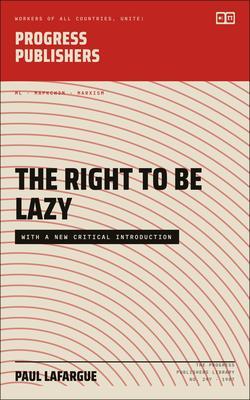
The most famous thing Lafargue wrote, and one of the most quoted texts in the history of socialism - and, for a century, oddly homeless. Too funny for the theoretical journals, too heretical for the movement's official catechisms, too obviously right to be forgotten. It keeps being rediscovered, and the rediscoveries keep not quite arriving.
He wrote it as a run of articles in the French workers' weekly L'Egalite in 1880, and gave it its finished shape, with the preface printed here, in 1883, while serving a sentence in the Sainte-Pelagie gaol in Paris for agitating among workers.
Its target is named in its subtitle: the right to work, the demand the revolutionaries of 1848 had carved on their banners. Against it Lafargue set the right to idleness, and he meant it.
He was no bohemian outsider. Born in Santiago de Cuba of mixed Caribbean, Creole and French descent, he became with Jules Guesde a founder of the Parti Ouvrier, the first organised Marxist party in France, and he married Laura, Marx's second daughter. He and Laura ended their lives together in 1911, reasoning that they had given what they could and would not outlive their usefulness. It was of Lafargue's French disciples that Marx made his weary remark that, whatever else was certain, he himself was not a Marxist.
What the book gets right it gets right early. Its real subject is not laziness but the manufacture of the work ethic - the way the compulsion to labour has been dressed by priests, professors and newspaper moralists as a law of nature and a duty of the soul.
New critical introduction by Dmitry Chasovennikov.
Es wurden noch keine Bewertungen abgegeben. Schreiben Sie die erste Bewertung zu "The Right to Be Lazy" und helfen Sie damit anderen bei der Kaufentscheidung.